!IMPORTANT! Migration and Legacy Integration Product Announcement!
MIGRATION TO W PRODUCTION
Q: Why is JOYN FDG migrating to W Production (formerly JOYN OG)?
JOYN FDG, while a reliable tool, is built on older technology that faces increasing limitations. These limitations hinder performance, compatibility, and our ability to innovate. The migration to W Production addresses these challenges and offers a more modern, streamlined platform.
Q: What specific limitations are driving the migration?
Compatibility:
Incompatibility with newer iOS versions on the mobile app causes performance problems.
Reliance on unsupported Microsoft components impacts the legacy Windows application.
Functionality:
Lack of Android support limits user accessibility.
Performance:
Experience significantly improved performance, especially under heavy load, thanks to our new APIs built on the latest technology stack and specifically architected to handle large-scale usage.
Innovation:
The older tech stack restricts our ability to deliver the customer-driven enhancements you need.
Q: What are the key benefits of migrating to W Production?
Unified Platform:
Combines the three core modules (FDG, Allocations, and FSM) for seamless integration and streamlined workflows.
Modern Technology:
Removes dependency on outdated middleware and embraces modern REST APIs for enhanced connectivity.
Introduces an industry-leading real-time allocations engine, driving efficiency in production accounting and field operations.
Q: Will the migration disrupt my current workflows?
We aim to make the migration as smooth as possible. We'll provide detailed guidance and support throughout the process, ensuring a seamless transition with minimal disruption to your operations.
INTEGRATION UPDATES
Q: What is changing with the JOYN FDG integration?
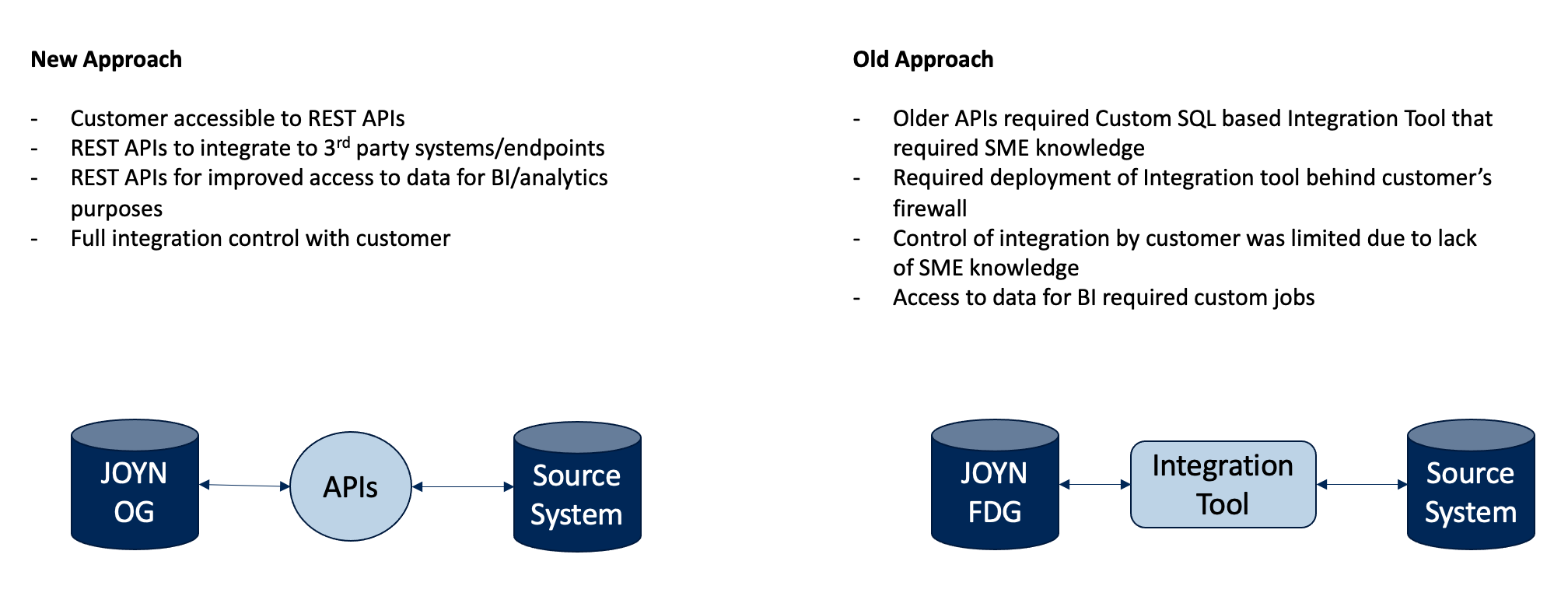
A: W Energy is transitioning from a custom, in-house integration service to a standard REST API approach for integrating JOYN FDG with various Production Allocation systems. This change is driven by the industry's growing familiarity with REST APIs and the need to move away from the unsupported .NET 4.5 framework on which the custom integration was built.
Q: Why are the integration changes necessary?
A: The custom integration service was developed when REST API expertise was less common in the oil and gas industry. With the wider adoption of REST APIs, W Energy is aligning its integration strategy with industry standards, offering a more robust and maintainable solution. Additionally, Microsoft has ended support for .NET 4.5, making it crucial to migrate to a supported framework to ensure security and compatibility.
Q: What are the benefits of moving to a REST API-based integration?
Industry Standard: Aligns with current industry best practices for data integration
Enhanced Security: Eliminates reliance on an unsupported .NET framework
Improved Maintainability: Simplifies future updates and enhancements
Greater Flexibility: Enables integration with a broader range of systems and tools
TIMELINES
Q: What are the recommended timelines for migration of the platform and the integration?
A: W Energy strongly recommends migrating to the new platform as soon as possible to gain the benefits of the new platform and to avoid disruptions due to externalities from larger companies.
Similarly, we also recommend moving to REST API-based integration as soon as possible as well. While the custom integration service will continue to function for a limited time, it's crucial to plan your migration to avoid potential disruptions and security risks. We will provide API support/training to assist customers during this transition.
RISKS OF NOT MIGRATING
Q: What are the potential risks of not migrating?
Security Vulnerabilities: The unsupported .NET 4.5 framework poses a security risk, leaving your systems open to potential exploits.
Compatibility Issues: Future updates to the W Production system or your 3rd party Production Allocation systems may not be compatible with the custom integration.
Limited Support: W Energy's ability to provide support for the the legacy product and the custom integration will diminish over time.
Integration Disruptions: Unexpected issues with the custom integration could lead to data inconsistencies or system downtime.
CHANGE MANAGEMENT
Q: What kind of change management is needed for this transition?
A: To ensure a smooth transition, we recommend the following change management activities:
Admin Basic Training: This will involve some basic training to familiarize your administrators with the new system's configuration and management features.
REST API Training: Provide training on standard REST-based APIs, particularly focusing on how to identify and utilize the necessary resources for integration. This may require a more significant time commitment due to its technical nature.
App Download and Familiarization: Instruct users to download the new app from the app store and provide brief training on the updated features, user interface, and performance improvements.
We understand that the API integration may require additional effort. However, the app itself should be relatively straightforward to adopt due to its similarities with the previous version. We'll provide comprehensive support and resources to assist with all aspects of the transition.
EXAMPLE SCHEDULE
Q: What does the typical migration plan look like?
# | Data | Phase | Details | Timeline | Responsible |
1 | Metadata | Migration | Move from JOYN FDG Stage to JOYN OG Stage | Within First 2 weeks | W Energy |
2 | Master Data | Migration | Move from JOYN FDG Stage to JOYN OG Stage | Within First 2 weeks | W Energy |
3 | Transaction Data | Migration | Move from JOYN FDG Stage to JOYN OG Stage | Within First 2 weeks | W Energy |
4 | DR Setup | Migration | Move from JOYN FDG Stage to JOYN OG Stage | Within First 2 weeks | W Energy |
4 | Mobile App | Migration | Deliver new stage app | Within First 2 weeks | W Energy |
5 | Milestone 1 | Migration | Sanity check JOYN OG Stage environment | Within First 2 weeks | W Energy |
6 | Metadata | Migration | Move from JOYN FDG Prod to JOYN OG Prod | Within First 2 weeks | W Energy |
7 | Master Data | Migration | Move from JOYN FDG Prod to JOYN OG Prod | Within First 2 weeks | W Energy |
8 | Transaction Data | Migration | Move from JOYN FDG Prod to JOYN OG Prod | Within First 2 weeks | W Energy |
9 | DR Setup | Migration | Move from JOYN FDG Prod to JOYN OG Prod | Within First 2 weeks | W Energy |
10 | Mobile App | Migration | Deliver new prod app | Within First 2 weeks | W Energy |
11 | Milestone 2 | Migration | Sanity check JOYN OG Prod environment; deliver to customer | Within First 2 weeks | W Energy |
12 | Milestone 3 | Migration | Test JOYN OG Prod Migration; sign off and prepare for integration phase
| Step 11 + 2 weeks* | Customer |
13 | Metadata | Integration | Integrate source system lower environment to JOYN OG Stage | Step 12 + 4 weeks* | Customer |
12 | Master Data | Integration | Integrate source system lower environment to JOYN OG Stage | Step 12 + 4 weeks* | Customer |
13 | Transaction Data | Integration | Integrate source system lower environment to JOYN OG Stage | Step 12 + 4 weeks* | Customer |
14 | Milestone 3 | Integration | Sanity check JOYN OG Stage integration | Step 13 + 1 week* | Customer |
15 | Metadata | Integration | Integrate source system prod environment to JOYN OG Prod | Step 14 + 4 weeks* | Customer |
16 | Master Data | Integration | Integrate source system prod environment to JOYN OG Prod | Step 14 + 4 weeks* | Customer |
17 | Transaction Data | Integration | Integrate source system prod environment to JOYN OG Prod | Step 14 + 4 weeks* | Customer |
18 | Milestone 4 | Integration | Sanity check JOYN OG Prod integration | Step 17 + 1 weeks* | Customer |
19 | Transaction Data | Go Live Migration | Move delta transaction data from JOYN FDG Prod to JOYN OG Prod | Within 2 weeks of completing Step 18* | W Energy |
*Estimates only - actuals may depend on resource time commitments
NOTE: The above may be faster for customers who have already migrated to JOYN OG but are still on the old Integration Product.
GETTING STARTED
Q: How can I get started with the migration?
A: Contact your W Energy representative to discuss your specific migration needs and timeline. We will provide you with the necessary resources and support to ensure a smooth transition to the new REST API-based integration. For information on our new APIs - check out our API FAQs: https://w-user-documentation.scrollhelp.site/production/joyn-o-g-api-faqs
Remember: Migrating to W Production isn't just about addressing limitations; it's about embracing a future of enhanced performance, seamless integration, and innovation. We understand that change can be challenging, but we're committed to helping you through this transition. By migrating to the new platform and integration approach, you'll benefit from a more secure, flexible, and future-proof solution for running W Production and/or integrating W production with your Production Allocation systems.